The Rebirth Method
Body. Emotions. Mind.
Three ways into the same conversation. Your nervous system runs through all of them. Rebirth brings somatic and fascia work, coaching and physical care together, with identity as the overarching focus: how you see yourself, and how you want to experience your life.
You understand the pattern. You have talked it through. Yet the same pressure still shapes how you stand, what you say and which choices feel available. Rebirth gives that connection sustained attention: physical patterns, emotional responses and the beliefs you keep living by.
The neuroscience of learning, interoception and two-way body–brain signalling informs our approach. Interoception is how you sense your internal state; neural plasticity is the nervous system’s capacity to learn through experience. These principles give us a grounded way to connect physical care, felt experience and coaching.
Body is the foundation. Emotions are the centre. Mind is the lens. Identity gives the work its direction.
01
Body
The foundation: posture, movement and physical habits.
The shoulder you keep lifting. The side you favour. The posture you return to at your desk. We assess spinal function, movement, muscular asymmetries and areas of bracing, considering physical demands alongside the situations in which tension returns.
Movement and postural guidance, practical ergonomics and targeted spinal adjustments are selected from your assessment. Comfort, function and the demands of your actual life guide the work — not an idealised posture.
02
Emotions
The centre: the connection between feeling, thought and body.
Pressure can narrow your thinking and tighten your muscles. Guilt can make rest feel uncomfortable. The need to prove yourself can keep you pushing past what feels manageable. We look at these familiar emotional responses, not only the circumstances around them.
Somatic Experiencing, gentle exercises and focused fascia work bring attention to sensation and tension. We notice what happens physically when pressure rises, and practise responses that fit how you want to live. Not forced positivity: staying present in a conversation, noticing a limit or speaking without the same need to prove yourself.
03
Mind
The filters: what you believe, expect and keep telling yourself.
Some thoughts feel less like thoughts and more like facts: I cannot slow down. I have to keep everyone happy. This is just how I am. We examine the beliefs, values and assumptions beneath those responses, including what still serves you and what no longer does.
Coaching and guided meditation bring familiar loops into focus, alongside the responses you want to practise. We give attention to what you are moving towards, rather than spend every session rehearsing the same difficulty. The work is about choice, not policing every thought.
The nervous system throughout
The thread through
the whole model.
Your autonomic nervous system helps regulate heart rate, breathing and digestion. Sympathetic activity mobilises resources for action. Parasympathetic activity supports recovery and digestion, with the vagus nerve carrying many of its signals. These systems work together; they are not a simple stress-versus-safety switch.
Stress also involves hormonal signalling. Cortisol, often called the stress hormone, helps make energy available and varies naturally through the day. Biochemical balance means coordinated physiological regulation, not having no stress hormones. Sleep, illness, medication and daily demands all matter; tension alone does not tell us what your hormones are doing.
In sessions, we consider your experience of sympathetic and parasympathetic nervous-system states: what you notice when you are activated, what allows recovery and what keeps repeating. We do not diagnose a precise autonomic state from posture or breathing, or claim to correct a hormonal imbalance through this work.
The aim is more flexibility in daily life: engaging with a demand, speaking clearly, making a choice and recovering afterwards. We connect physical care and felt experience with the beliefs and habits surrounding those responses.
The emotional work
Emotions are not
an afterthought.
They sit at the centre of Rebirth because they connect what you think with how your body responds. Knowing you can say no is different from feeling able to say it. Wanting to speak is different from the pressure that makes you hold back.
This is embodiment: experience expressed through breathing, muscle tension, posture and movement. Emotions are the engine of our model because they give the work a felt context. We notice the physical response, examine the meaning around it and practise the choices you want to make.


The body–brain loop
Signals travel in both directions:
Bottom-up
Signals from
the body.
Top-down
Thought and
meaning.
Interoception is your sense of what is happening inside your body: a heartbeat, a held breath, a feeling of tightness or ease. These signals help shape emotional experience. What you think they mean can shape your response in return.
We work with both. When the mind keeps rehearsing the same explanation, we attend to the physical response. When a sensation feels threatening, we examine the meaning around it. The body and the thinking mind belong in the same conversation.
You do not need to force a feeling
Being told to relax can become another demand. So can being told to think positively. We begin with what is actually there, noticing tension, sensation and moments of ease without asking you to manufacture a different mood.
Somatic Experiencing in sessions
Somatic means working with bodily experience. Here, attention to sensation, breathing and gentle movement helps us explore how stress is felt: the muscle that tightens, the breath that stops, the impulse to pull away. There is room to pause, and no requirement to revisit every detail of an experience.
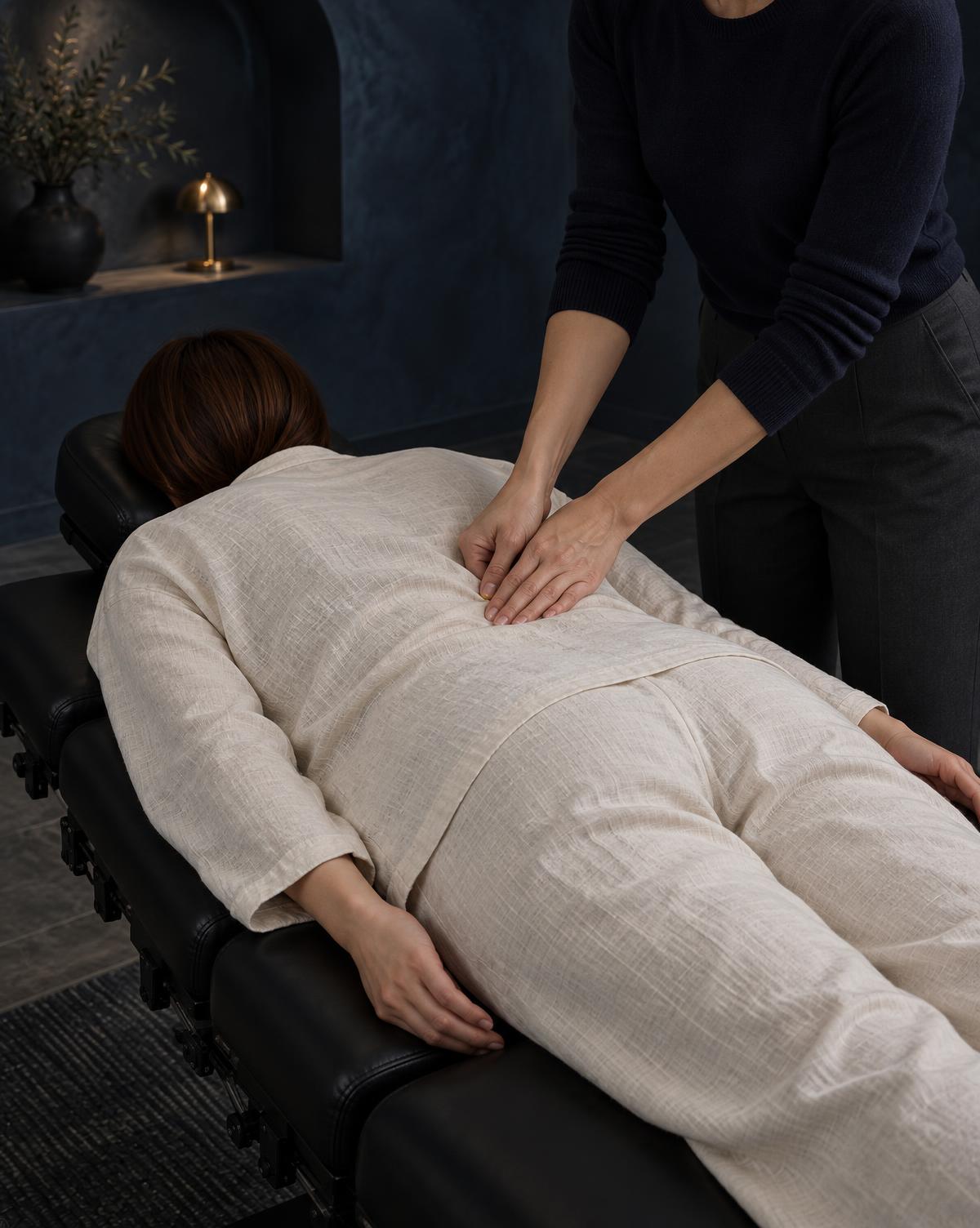
Fascia is connective tissue surrounding and supporting structures in the body. Focused fascia care sits within this emotional layer of our model because we consider physical tension alongside emotional experience. We assess sensitivity, movement and tension; these findings guide the hands-on work, rather than assuming a tight area contains a particular emotion.


Identity — the umbrella
Familiar does not have
to mean fixed.
Being the dependable one. The one who never stops. The one who keeps the peace. These descriptions can feel like facts about who you are, even when they carry a cost.
Identity is the picture you hold of yourself. Your physiological blueprint is our metaphor for the familiar physical, emotional and mental responses that accompany it: how you brace, what you expect and how you react. Neither is a complete explanation of your health, or something we can read from your posture.
We keep returning to the way of being you want to develop: speaking with conviction, making choices from your values, carrying yourself without the same demand to prove. We connect that direction to what you practise across body, emotions and mind. Not an ideal personality to chase — more choice in your actual life.
We make room for what you are moving towards, not only what you want to leave behind.
The Experience
First, we understand
the pattern.
Your first session is a 60-minute initial consultation: time for an in-depth assessment across mind, emotions and body. We want to understand the responses you return to most often, not simply where you hurt today.
- Initial consultation
- 60 minutes
- Follow-up session
- 30 minutes
Loops, stories and identity
We examine recurring thought and response loops, familiar stories, your current sense of self and what feels limiting. What does the pattern ask of you? Where does it seem automatic? What are you ready to give more attention to?
Fascia, tension and asymmetry
We assess areas of fascial and muscular tension, sensitivity and asymmetry alongside your experience of stress and relevant history. This gives physical findings and emotional experience a place in the same assessment.
Posture, spine and movement
We look at how you stand, move, favour one side or brace, and assess spinal function. Your daily demands, physical habits and experience of pressure provide the context: the body you live in, not an isolated set of measurements.
Nervous-system responses
We discuss what activation and recovery feel like for you, and observe breathing and tension in context. Sympathetic and parasympathetic activity inform the explanation; your history and daily experience guide the assessment. Hormone levels, including cortisol, cannot be determined from these observations.
Follow-ups are 30 minutes each. We revisit what is changing and continue the relevant fascia, somatic, coaching and physical work. Your plan connects the assessment with the sessions and supporting content, leaving room to refine the approach.
Understanding
We begin with your health history, physical assessment and what you notice in daily life. We ask what you have already tried, where you feel limited, and what matters to you. Together, we build a working picture rather than rush to a single explanation.
Individual care
Fascia and somatic work, coaching, meditation and targeted physical care are connected through your plan. We explain the purpose of each recommendation. Your assessment and response set the emphasis, rather than a fixed routine.
Refinement
We return to what is changing: your comfort, movement, emotional responses and the ways you handle familiar pressure. We keep useful practices, reconsider what is not helping and review whether further assessment or other care is needed.
Assessment combines physical findings with your account of experience; tension and posture are not proof of stored trauma or a particular identity, and routine observations do not diagnose sympathetic dominance or a precise vagal state. Hands-on care follows the assessment and your consent.

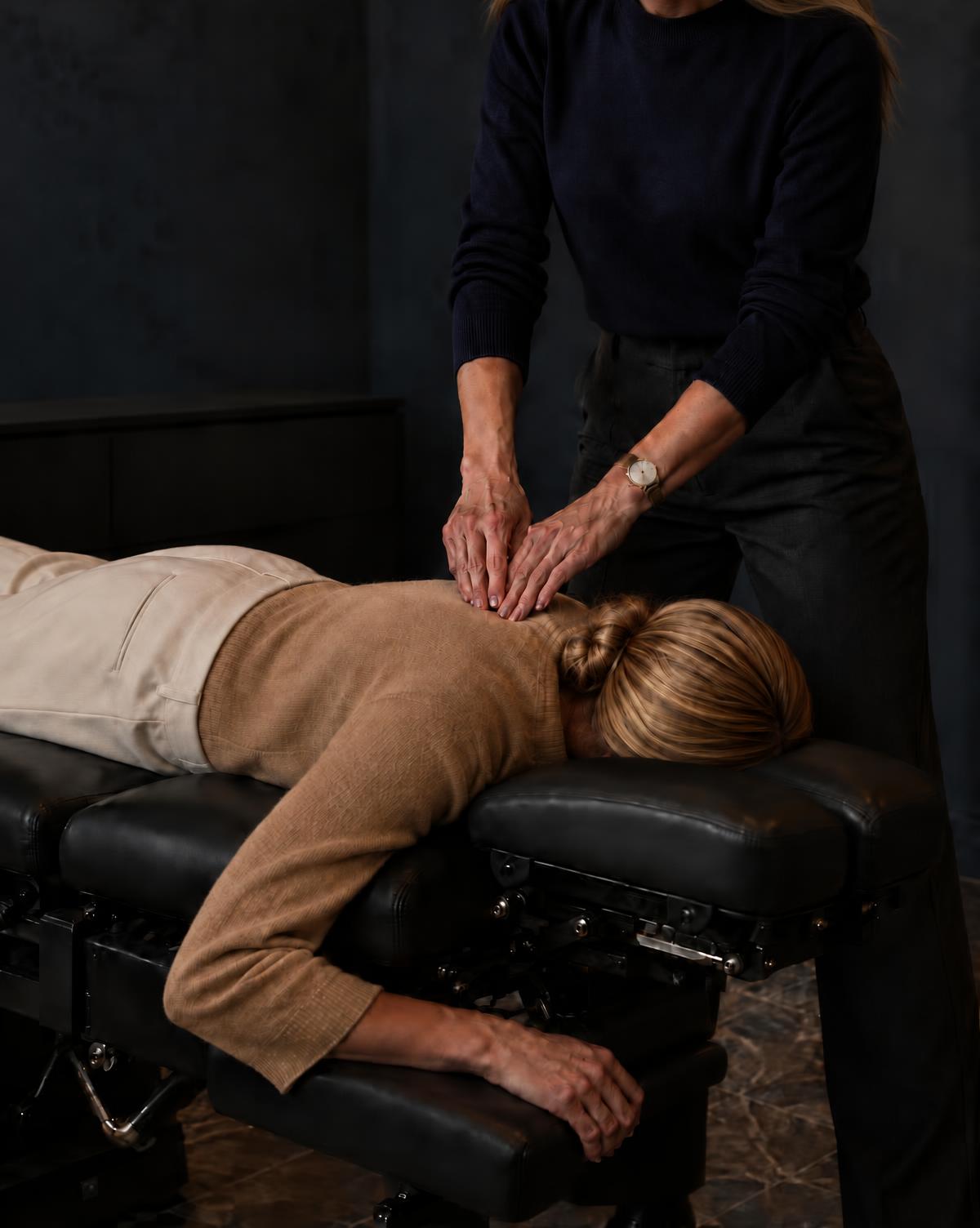
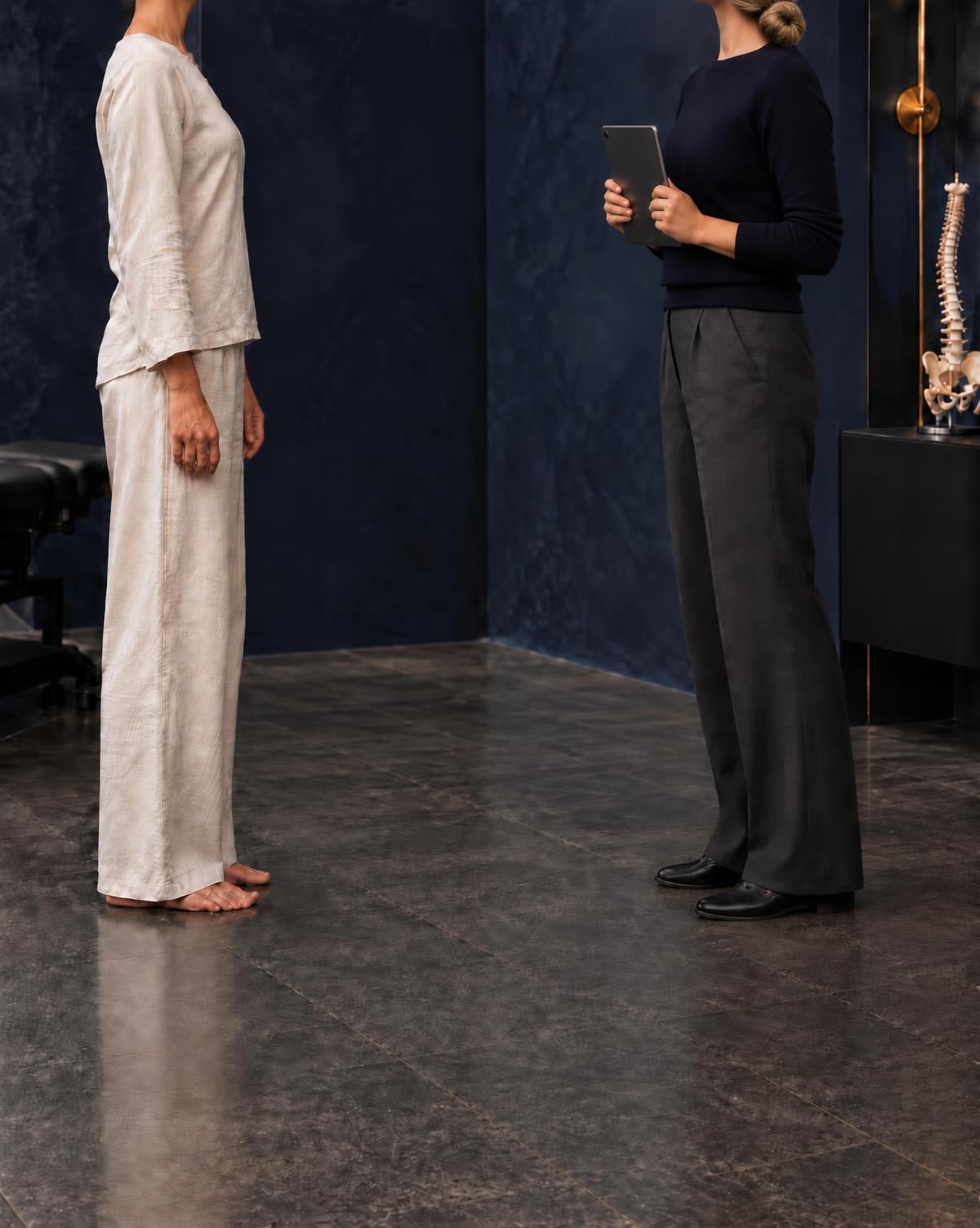


The quieter room is only part of the work. We want to know what happens when you return to your desk, a demanding day or a familiar conversation. That is where we review whether the approach is making a useful difference.
Discuss Your Care PlanBefore you begin
- Is this coaching, somatic work or physical care?
- Rebirth connects these approaches, including fascia work, rather than define the whole model through one treatment. Teresa is a Master’s graduate in Neuroscience, ICF-qualified coach and chiropractor. Your assessment determines the emphasis. Coaching is not a substitute for psychological therapy or psychiatric care.
- What is the neuroscience basis?
- Learning, bodily perception and the influence of expectations are the principles behind the approach. Teresa’s Master’s in Neuroscience informs how these are brought into practice. Evidence for those principles is not the same as clinical validation of Rebirth as a combined programme; your response is reviewed throughout care.
- What if I already receive other care?
- Tell Teresa what you are doing and what has helped. We consider Rebirth alongside your current care, rather than replace what is useful. Persistent, new or changing symptoms warrant appropriate medical assessment.
- How is my plan decided?
- From your history, assessment, priorities and response. We discuss recommendations before care begins and review them as we go. There is no universal number of visits or guaranteed result, and you do not need every element in equal measure.
Available now / The Rebirth capsule
The work begins.
The space is coming.
A capsule of Rebirth is available now: the sessions, the model and supporting content, brought together in individual care. Somatic and fascia work, coaching and physical care under one roof — one practitioner, one connected plan. Begin the work while the full Rebirth space takes shape.
Capsule sessions take place in a private space in Bondi Junction. The official Rebirth location is still in development; the interiors shown here express the atmosphere of that future space, not the current session venue.
We begin with a 60-minute initial consultation, followed by 30-minute sessions within your individual care plan.
Watch this space. There is more Rebirth to come.